Sunday, May 28, 2017


5/28/17

Face Off!


We make instant judgements all the time about people based only on what they look like.  That can be really misleading.  Notorious serial killer Ted Bundy was an attractive charmer as well as a kidnapper, rapist, murderer and necrophile. Sadly, for all the women he harmed, you sure couldn’t tell from his smiling face.

But what if you could tell which people were more likely to be violent, just by looking at them? That would be handy. And it turns out you can. Sort of. 

Look at the two guys at the top of this blog. Just off the top of your head, which one do you think is more likely to take a swing at someone? If you said the guy on the left, you’d be right.  He’s the white supremacist who was just arrested for murdering several good Samaritans on a Portland commuter train this past week. The guy on the right is hockey superstar Wayne Gretzky. Yes, hockey players are violent by profession, but Gretzky is less violent than many.

So what’s different in their faces? Gretzky, the guy on the right, is smiling while the guy on the left is posing for his mug shot and is probably not too happy about it, but that's not all.  The very shape of their faces hints at the possibility of violent behavior. Here's how:

Back in 2008, Canadian researchers Justin CarrĂ© and Cheryl McCormick wanted to know if there was a relationship between facial structure and aggressive or violent action. The answer was yes, but only in men.  And the relationship is this:  Men whose faces are broader are more likely to be violent than those whose faces are narrower.   

To measure this, they compared the width of the face to the height (from upper lip to eyebrow). Here are some images from their study.


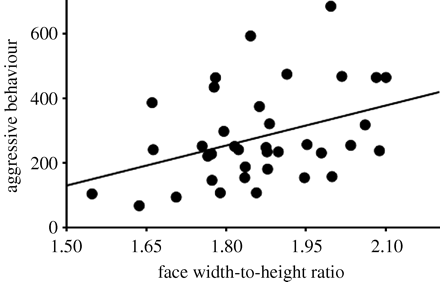
They found the broader the face (the higher the ratio), the more likely the person was to be aggressive in a game situation. Being Canadians, they then looked at hockey players. They found the broader the face, the more time the player spent in the penalty box, whether they were college players or professional members of the National Hockey League.

I’ll get to the actual data below, but right now let’s look at what other scientists have found since 2008, using the same measuring guidelines.  Researchers discovered that men with broader faces are more socially dominant. They are more likely to retaliate to perceived slights. They are more likely to act in their own self-interest, even if it means violating the trust of another. And so on.  It seems to be tied to testosterone. In general, the broader the face, the higher the level of testosterone, which might be the underlying element that explains what’s going on.

BIG WARNING:  Lots and lots of things contribute to a person’s violent behavior besides testosterone: Did he just lose his job? Was he abused as a kid? Did his sweetie just leave him? Was he drinking? Was he raised in a culture of violence?  Was he just involved in a high speed police pursuit? You can’t only go by faces.  These factors are important, too.  Also, while this relationship between face metrics/testosterone and violent behavior has been found over and over again, it only explains a relatively small part of why a person might act out. As tempting as it might be, I recommend that you don’t go taking selfies with folks and then running to find a ruler to see how they measure up.  This will solve no problems and win you no friends.

But we can certainly take a look at some famous people, right? So let's go back to those two guys at the top, the racist and The Great One, and draw some lines of our own.


The ratio for the guy on the left is 2.2.  If he played hockey, that would make him one of the more violent hockey players in the League.  The ratio for Gretzky on the right is 1.6.  His lifetime average penalty minutes is around 1/3 of a minute a game.  Twenty-three seconds. Just saying...


The Data:
Here are some of CarrĂ© and McCormick’s original data.  (Yes, I love me some graphs!) This first one, using college students, compares the face width-to-height ratio with how aggressive they got in a gaming situation that encouraged competition. The broader the face (bigger numbers along the horizontal axis) the more aggressive they were in the game. Notice that the broadest face score for the college students was 2.10


Now let’s look at college hockey players.  The horizontal line again shows the face width-to-height ratio (bigger number = broader faces), but this time the vertical line represents real world violence, in this case minutes in the penalty box.


 And here’s the data for all the players in Canadian NHL teams.


You'll notice that the trend line, that diagonal line across the graph, isn't very steep. That means the relationship isn't a very strong one.  (Tricky statistical stuff coming up. You've been warned!)  This is because the shape of the face/testosterone only accounts for about 15% of the reasons that these people are acting violently.  If I knew more about hockey, I could probably suggest some of what the other 85% of the reasons are, but I would guess things like their experiences playing hockey as kids, how much they get paid or praised for slamming someone, whether their sweeties go to their games and cheer them on, and so on.  

On the other hand, that 15% is very, very robust: Just about the same amount shows up in study after study. That means we need to pay attention, that it's important.  Something to keep in mind.

Ted Bundy


Saturday, May 13, 2017

5/12/17

Cuba, Part III

Some loose ends from our Cuba trip:  The Bay of Pigs and the Cuban Missile Crisis.

THE BAY OF PIGS
The beautiful bay.


Is gorgeous.  A real tourist and diving attraction.  Back in 1961, the story was much different.  At the height of the Cold War, here were suddenly Communists, a mere 90 miles off the Florida coast. Late in his second term, Eisenhower and the CIA hatched a plot to invade Cuba to remove Castro and his ilk. Three months into his presidency, JFK decided to implement it. 

The plan was for this force to land on the beach at the Bay of Pigs and immediately declare themselves the official Cuban government.  Then they could invite the US to come in and help round up the revolutionaries.  To this end, the CIA recruited fighters among the Cuban exiles in Miami, a move that was soon more public than secret.  In fact, the Cubans knew so much about what was planned that they were sitting on the beach on that dark night in 1961, waiting for unsuspecting force to arrive. More than 100 of the incoming force were killed.  Of the remaining 1,200, a few were tried and shot.  Almost all the rest were eventually returned to the US in exchange for a ransom of $53 million worth of baby food and medicine.

What a mess.

I didn’t know much at the time – I was 15 and uninterested in world affairs – and even I could tell it was a dumb idea.  The Cubans have a museum there at the Bay and are very happy to show Americans around and remind them how badly things went.


CUBAN MISSILE CRISIS
In October of 1962, US spy planes discovered that Russia was constructing nuclear missile sites on Cuba. After much agonizing, President Kennedy called for a “quarantine”, a naval blockade of the island country, to stop the arrival of any additional military supplies. Then he demanded the removal of the missiles already there and the destruction of the sites.  And the world held its breath. 


I thought we were all going to die.

But we didn’t!


The Cubans knew almost nothing about this while it was happening.  It was a thing between Russia and the US.  They only learned later.  Phew.  Secretly, in exchange for Russia backing down, the US would remove its missile sites from Turkey and Italy. Our Cuban guide said the missile sites in Turkey were never removed. He was misinformed.  Ahem. The last missile was removed in the spring of 1963.

Most of this information came from the JFK presidential library site.  https://www.jfklibrary.org


Sunday, April 23, 2017

4/23/17


Why science is so hard to believe
OR
It’s turtles, all the way down*


Wait. What?  What’s so hard to believe about science? And yet it is hard.  I, for one, had to be trained to do it. To think like a scientist, we need to be willing to give up one fact for a better fact. To think like a scientist, we need to be willing to look beyond information that confirms what we already know and dip our toe into opposition thinking. To think like a scientist requires us to, well, think.

Take climate change, for example. While I have very little training in planetary science, I know how to read a research report and understand some/a little, depending. So in preparing this blog, I looked over The Stern Review, issued by the government of the United Kingdom.  It looks at the evidence for climate change and then the economic consequences.  It’s very readable. It also gives links to the original research, which is really important because Stern is summarizing what someone else wrote.  After a while, though, you don’t need to read every single paper.  The evidence is overwhelming.  The climate is changing, and the Earth is getting warmer.

Here’s some scientific evidence:


I like graphs, but they're not everyone's cup of tea. As an alternative, here's something non-scientific:

Muir Glacier Alaska.
The left side is August 13, 1941. The right side is August 31, 2004


So given that kind of evidence, why is it so hard to get people to believe the planet is getting warmer?

Part of that is confirmation bias, the inclination to only absorb information that agrees with what we already believe. But beyond that, something like personal experience can outweigh  abstract scientific findings.  Here's a great example. Imagine, first, a map of the United States.  If you had to guess what parts of the country contained people who believed in global warming and what parts don’t, you might come up with something like this from Yale University:


More than half the people in the orange/yellow zones report being worried about climate change.  Looks a bit like Clinton’s 2016 election map, right?  Well, except for Texas and Florida. But don’t jump to the conclusion that it’s a political thing alone. Here’s a map that shows where it actually IS getting hotter or colder based on record temperatures.


Scroll up and down. Notice how similar the maps are.  So how can we expect an average citizen in Tennessee or Kentucky -- already being told by their conservative media that climate change is a Chinese conspiracy -- how can we expect them to believe that the planet is getting warmer when their own experience is the opposite? That’s a tough clean and lift for most.

Here’s the original paper that identified these maps. 
And here’s a more accessible description of the results. 


However, lest anyone think I'm only targeting the right, there are also science deniers on the left.  Consider attitudes towards GMOs.

Genetically modified organisms have had genetic material from other organisms spliced into their DNA. In food products, the intent is to increase production and resistance to pests.  In the case of my Type I Diabetic husband, this means that altered e-coli can now produce human insulin that has kept him healthy and seeing and walking even after 40 years with the disease.

Anyway, more food to feed a growing world population. How is that a problem?  Genetic modification developed modern corn, for example.

Development of Corn over Time


An enlightening discussion with a botanist friend last weekend suggested that people worry about some kind of accidental transmission of undesirable contamination to the human population.  I get that.  Science can be wrong, sometimes dramatically and tragically wrong. You don’t need to look farther than Thalidomide to see how badly that can turn out. But are we wrong here?  The consensus (95% of studies) suggests that we’re not.  Here’s a summary that also looks at potential conflicts of interest in the research studies. LINK.

And while we’re talking about left wing anti-science attitudes, let us not miss the chance to take another potshot at the anti-vaccination crowd.  The latest suggests that some vets are identifying autism in dogs. Yes, dogs.  And somehow, just after vaccination.  Really? But I can’t make too much fun of these people.  We don’t know what causes autism, yet it can be devastating to every member of the family.  The need to find a cause and hold someone/something accountable must be enormous. 

But while I can understand part of the mind set that is driving some of these parents, the danger of not vaccinating children is clear, especially to babies who are too young to get their own immunity. Many states are setting more rigid guidelines for vaccinations in the hopes of preventing the return of childhood diseases we thought had finally been stopped.

And this brings us finally to my favorite Latin saying:  Post hoc, ergo propter hoc.  It describes a logical fallacy that says, because event Y follows event X, event Y must have been caused by event X. 

“My child showed the first symptoms of autism right after he got his first vaccinations. Therefore, the autism was caused by the vaccinations.”  But really, it’s just like saying, Dawn occurred right after the rooster crowed, therefore dawn was cause by the rooster crowing. 

Our brains are hard wired to interpret temporal connections as causal connections. It’s very, very hard to get past that. It requires thinking, which, I believe, is where we came in.

Now, about those turtles:

*According to Stephen Hawkings in his book, A Brief History of Time, the phrase, "It's turtles all the way down," originated from a conversation that occured directly after a speech which described how the earth revolves around the sun.  At the end of the speech an elderly lady stood up and said,

"What you have told us is rubbish. The world is really a flat plate supported on the back of a giant tortoise."

The scientist then smugly asked,

"What is the tortoise standing on?"

"You're very clever, young man, very clever", said the old lady. "But it's turtles all the way down!"