5/28/17
Face Off!
We make instant judgements all the time about people based only
on what they look like. That can be
really misleading. Notorious serial
killer Ted Bundy was an attractive charmer as well as a kidnapper, rapist,
murderer and necrophile. Sadly, for all the women he harmed, you sure couldn’t
tell from his smiling face.
But what if you could tell which people were more likely to
be violent, just by looking at them? That would be handy. And it turns out you can. Sort of.
Look at the two guys at the top of this blog. Just off the top of your head, which one do you think is more likely to
take a swing at someone? If you said the guy on the left, you’d be
right. He’s the white supremacist who was just arrested for murdering several good Samaritans on a Portland commuter train this
past week. The guy on the right is hockey superstar Wayne Gretzky. Yes, hockey
players are violent by profession, but Gretzky is less violent than many.
So what’s different in their faces? Gretzky, the guy on the right, is smiling
while the guy on the left is posing for his mug shot and is probably not too happy about it, but that's not all. The very shape of their faces hints
at the possibility of violent behavior. Here's how:
Back in 2008, Canadian researchers Justin
Carré and Cheryl McCormick wanted to know if there was a relationship
between facial structure and aggressive or violent action. The answer was yes, but only in men. And the relationship is this: Men whose faces are broader are more likely to be violent than those whose faces are narrower.
To measure this, they compared the
width of the face to the height (from upper lip to eyebrow). Here are some
images from their study.
They found the broader the
face (the higher the ratio), the more likely the person was to be aggressive in a game situation. Being
Canadians, they then looked at hockey players. They found the broader the face,
the more time the player spent in the penalty box, whether
they were college players or professional members of the National Hockey League.
I’ll get to the actual data
below, but right now let’s look at what other scientists have found since 2008, using
the same measuring guidelines. Researchers discovered that men with broader faces are more socially dominant. They are more likely to retaliate to
perceived slights. They are more likely to act in their own self-interest, even
if it means violating the trust of another. And so on. It seems to be tied to testosterone. In general, the broader the face, the higher the level of testosterone, which might
be the underlying element that explains what’s going on.
BIG WARNING: Lots and lots of things contribute to a
person’s violent behavior besides testosterone: Did he just lose his job? Was he abused as a kid?
Did his sweetie just leave him? Was he drinking? Was he raised in a culture of violence? Was he just involved in a high speed police
pursuit? You can’t only go by faces. These factors are important, too. Also,
while this relationship between face metrics/testosterone and violent behavior has been
found over and over again, it only explains a relatively small part of why a
person might act out. As tempting as it might be, I recommend that you don’t go taking selfies with folks and then running to
find a ruler to see how they measure up.
This will solve no problems and win you no friends.
But we can certainly take a look
at some famous people, right? So let's go back to those two guys at the top, the
racist and The Great One, and draw some lines of our own.
The ratio for the guy on the left is 2.2. If he played hockey, that would make him one of the more violent
hockey players in the League. The ratio for
Gretzky on the right is 1.6. His lifetime average
penalty minutes is around 1/3 of a minute a game. Twenty-three seconds. Just saying...
The Data:
Here are some of Carré and McCormick’s
original data. (Yes, I love me some
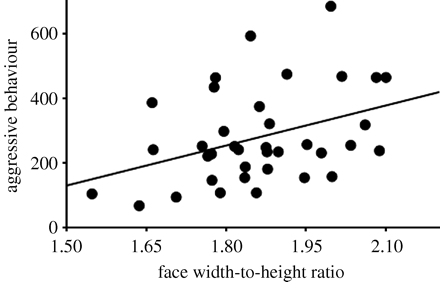
graphs!) This first one, using college students, compares the face width-to-height ratio with how aggressive they got in a gaming situation that encouraged competition. The broader the
face (bigger numbers along the horizontal axis) the more aggressive they were
in the game. Notice that the broadest face score for the college students was
2.10
Now let’s look at college hockey
players. The horizontal line again shows
the face width-to-height ratio (bigger number = broader faces), but this time
the vertical line represents real world violence, in this case minutes in the
penalty box.
And here’s the data for all the players in Canadian NHL teams.
You'll notice that the trend line, that diagonal line across the graph, isn't very steep. That means the relationship isn't a very strong one. (Tricky statistical stuff coming up. You've been warned!) This is because the shape of the face/testosterone only accounts for about 15% of the reasons that these people are acting violently. If I knew more about hockey, I could probably suggest some of what the other 85% of the reasons are, but I would guess things like their experiences playing hockey as kids, how much they get paid or praised for slamming someone, whether their sweeties go to their games and cheer them on, and so on.
On the other hand, that 15% is very, very robust: Just about the same amount shows up in study after study. That means we need to pay attention, that it's important. Something to keep in mind.
 |
| Ted Bundy |